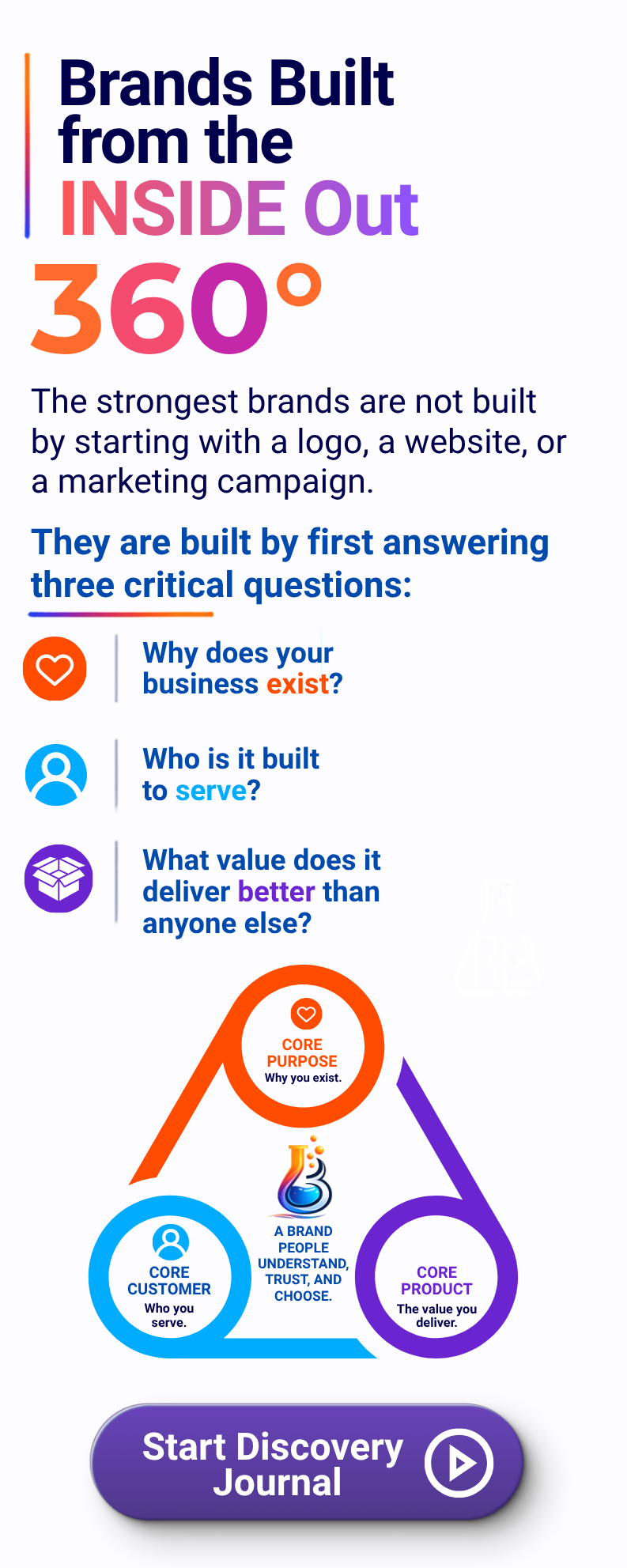
For more than two decades, I've worked inside businesses, alongside founders, with leadership teams, in business development, operations, customer experience, growth, and marketing.
And I've learned something important.
The strongest brands aren't built by marketing departments alone.
They're built by businesses that know who they are.
Earlier in my career, I might not have called all of it "brand."
I would have called it strategy.
Growth.
Operations.
Customer experience.
Relationship development.
Positioning.
Reputation.
But over time, I realized these things weren't separate.
Customers were experiencing all of them as one thing.
The brand.
Your Customer Doesn't See Your Departments
A customer doesn't care that marketing owns one part of their journey and operations owns another.
They don't distinguish between the promise made on your website and the experience delivered by your team.
To them, it's all you.
If marketing says one thing and the customer experiences another, trust erodes.
If business development promises something operations can't consistently deliver, trust erodes.
If leadership knows what makes the company special but employees can't articulate it, the brand becomes dependent on a handful of people.
And if a company grows faster than its story evolves, the marketplace may continue seeing a version of the business that no longer exists.
I've seen versions of all of it.
Growth Exposes What Isn't Aligned
When a business is small, the founder can carry the brand personally.
They know the story.
They know every customer.
They know why decisions get made.
They can explain the value.
They can protect the experience.
Then the company grows.
More people join.
More customers arrive.
More services develop.
More markets open.
More channels appear.
And suddenly, what used to live instinctively inside the founder has to become something the organization can understand and repeat.
That's where clarity becomes critical.
Brand Is the Thread
Today, this is one of the ideas at the center of BrandLabs:
Brand is the thread connecting what a company believes, what it promises, how it communicates, how it grows, and what people ultimately experience.
That's why I don't believe the first question should be:
"What should our marketing look like?"
I want to know:
Why does this business exist?
Where did it come from?
What did the founder see that others didn't?
Who does it serve exceptionally well?
What problem does it solve?
Why do customers stay?
Where is the company going?
What must never get lost as it grows?
Those answers give us something much more valuable than a campaign.
They give us a foundation.
And once that foundation is clear, design gets easier.
Messaging gets clearer.
Content gets stronger.
Business development becomes more consistent.
Customer experience becomes more intentional.
AI and search visibility have something meaningful to reinforce.
That's the work I'm interested in.
Not marketing for marketing's sake.
Building brands from the inside out—so the business people discover is the business you intended to build.