Here's a question every business leader should be asking:
If your ideal customer asked an AI platform to recommend companies like yours today, would your business make the list?
And if it did, would the description actually be accurate?
For years, businesses have worked to rank on Google.
They've optimized websites. Built backlinks. Created content. Managed listings. Invested in paid search.
Those things still matter.
But the way people discover businesses is changing.
Instead of searching:
"best commercial flooring company Charlotte"
someone can ask:
"Who are the most reputable commercial flooring companies in Charlotte that have experience working with multifamily developers?"
That's a fundamentally different search.
The user isn't simply asking for links.
They're asking for an answer.
Discovery Is Becoming a Conversation
Customers can now ask AI increasingly specific questions.
"Who specializes in this?"
"Which company is best for businesses like mine?"
"Compare these three companies."
"What should I look for before hiring one?"
"What are people saying about them?"
"What makes this company different?"
That changes what digital visibility means.
Being findable is no longer enough.
Your brand also needs to be understandable.
What Does the Internet Say You Are?
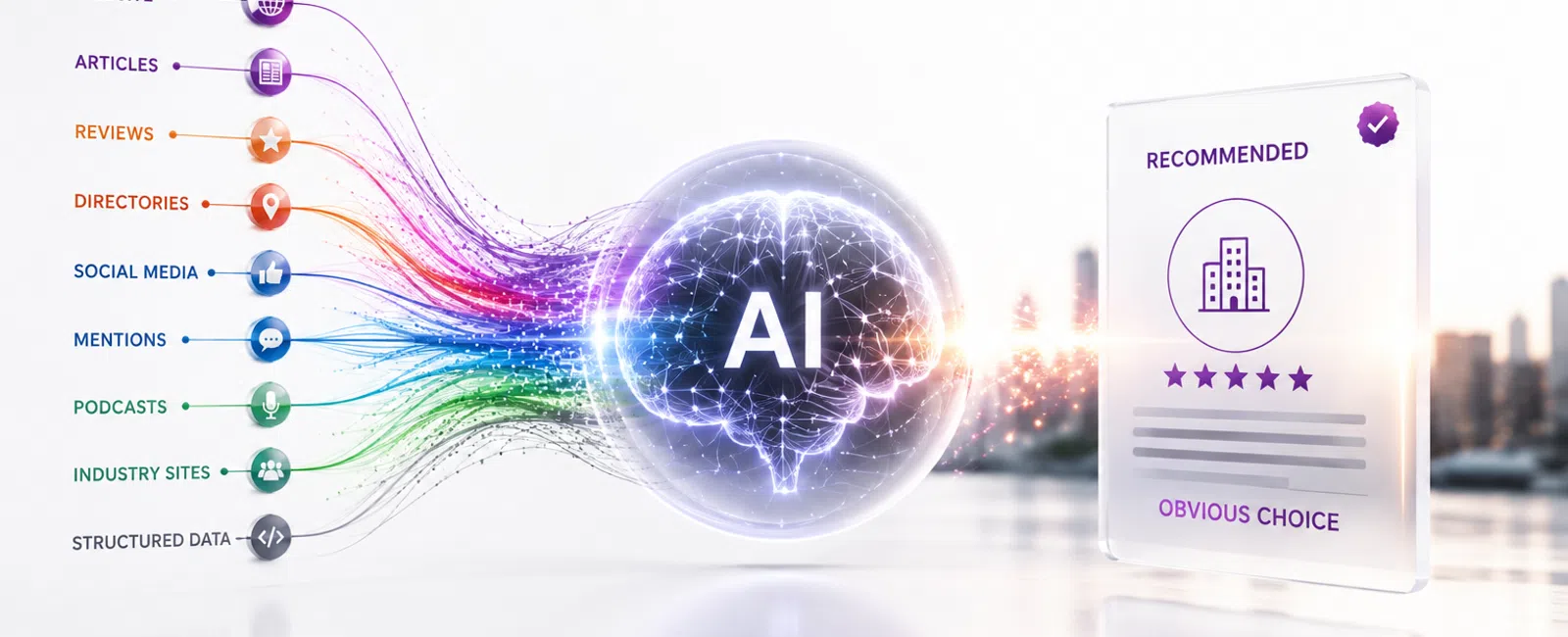
AI systems don't learn about your company from your homepage alone.
Your digital presence creates signals across the web.
Your website.
Articles.
Profiles.
Directories.
Media mentions.
Reviews.
Podcasts.
Social platforms.
Industry associations.
Structured data.
Third-party websites.
And the language other people use when talking about your company.
Together, those signals help create an understanding of who you are.
Which raises another question:
Is the story the internet tells about your company the same story you're trying to tell?
For many businesses, the answer is probably: not exactly.
A company may have evolved significantly while its digital footprint still reflects an older version of the business.
Services changed.
Markets expanded.
Leadership evolved.
Positioning matured.
Expertise deepened.
But online, pieces of the old story remain scattered everywhere.
This Is Bigger Than SEO
SEO has traditionally focused heavily on helping search engines discover and rank information.
The emerging challenge is broader.
Businesses need to think about authority, context, consistency, entities, expertise, and trust.
Can machines understand:
Who are you?
What do you do?
Who do you serve?
Where do you operate?
What are you known for?
What topics do you have authority around?
What evidence supports those claims?
How are you connected to other credible people, companies, industries, and ideas?
At BrandLabs, this is part of the thinking behind Brand AIM™—our approach to AI and search authority.
Because the next generation of brand visibility isn't simply about appearing in search results.
It's about becoming a brand that both people and machines can understand, trust, and confidently reference.
Try This
Open the AI platforms your customers may be using.
Ask them about your company.
Then ask about your competitors.
Ask who they recommend in your category.
Ask what your company specializes in.
Ask what differentiates you.
Don't treat the answers as absolute truth. AI systems can make mistakes, and results can vary.
Instead, use the exercise as a window into your digital footprint.
What does it understand correctly?
What's missing?
What's outdated?
Where is your authority clear?
Where is it weak?
Because there's a new question sitting alongside:
"Can customers find us?"
It's this:
"When they ask AI who they should trust, will it understand enough about our brand to include us in the conversation?"